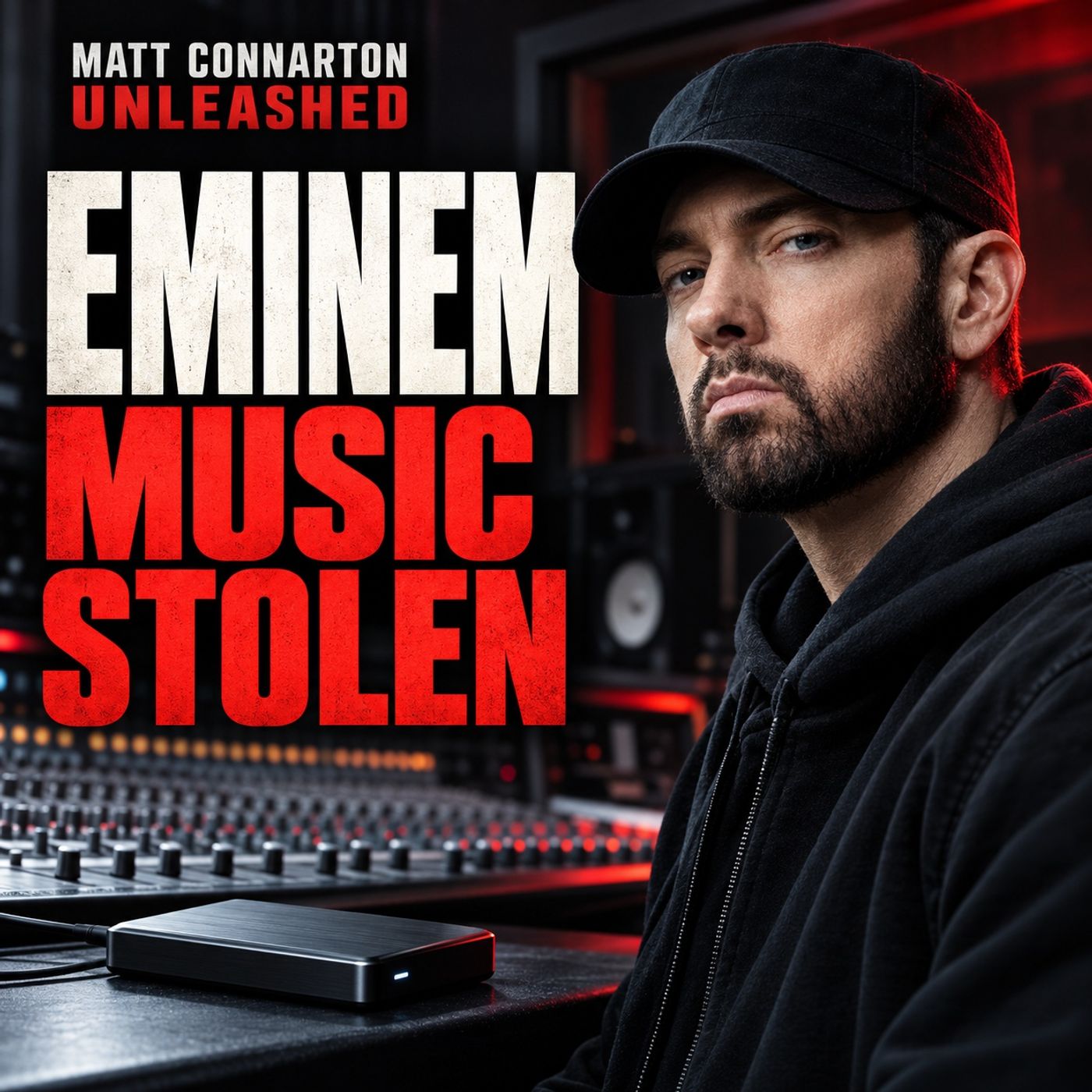
Eminem Music Stolen | Matt Connarton Unleashed
What's This About?
More from Matt Connarton Unleashed
Listen, watch, and explore more episodes at MattConnartonUnleashed.com
Want to be a guest on the show? Visit MattConnartonUnleashed.com and choose Be A Guest.
Follow the show, subscribe on your favorite podcast platform, and join us live for Matt Connarton Unleashed.
Talk. Music. Entertainment. Interviews. And More.
Speaker 1: We've got a little bit of time left.
Speaker 2: I did see some interesting music industry news. Boy, somebody's always in trouble for something, aren't they? This game is a bit of a shock. Musicbusinessworldwide.com. I'll explain the part. Part of this is not shocking at all, but I'll explain. Former Eminem employee pleads guilty to selling unreleased tracks that were later accessed 8 million plus times on streaming platforms. Now, Here's what's shocking and not shocking about that headline, and then we'll get into the story. By the way, I did not pre-read this, so I will be learning and surprised, I'm sure, with all of you.
Speaker 2: But the not surprising part is the former Eminem employee pleads guilty to selling unreleased tracks. It's a story as old almost as the music industry itself, probably almost, but where, you know, bootlegs, everyone... Everyone knows what bootlegs are. It's when you get a recording of something that was not officially released. And I don't know how common... Well, let me put it this way. I'm sure it's not nearly as common now in the digital age, but I'm sure that people do still circulate bootlegs on cassettes and CDs and probably not so much cassettes, but maybe cassettes, definitely CDs.
Speaker 1: You know, things still.
Speaker 2: People still... you know, circulate those, I'm sure. Uh, but, The part that is consistent here with present day is it's usually someone on the inside. If something leaks early, if an artist has recorded something that's meant to remain unreleased or it's not supposed to be released yet, but it leaks, it usually leaks because someone who works for them or maybe someone who is either on the team of the artist or someone who works for the record label who maybe wants to sabotage something for whatever reason.
Speaker 1: You know, it's always an inside job. It's not like somebody.
Speaker 2: somehow from the outside breaks in and steal something right uh when it comes to music it's always an inside job um that part is not a surprise that is consistent with how this works this is obviously a form of bootlegging what surprised me about it when i saw this headline was the eight million plus times that this has been streamed uh look i mean you know Bootlegs, popular bootlegs that circulate on the market. Again, to be old school about it, if it's a CD, there's not 8 million copies of that CD floating around, right?
Speaker 1: But my God. And I didn't know about this until today.
Speaker 2: So it says here, and again, this is from musicbusinessworldwide.com, which is one of my favorite websites to get music industry news. It says, a former employee of Eminem has pleaded guilty to a criminal copyright charge over the sale of the rapper's unreleased music. Joseph Strange, 48, of Holly, Michigan, sold 10 or more audio files of the music to buyers online for approximately $ 50, 000, according to court documents cited by the U.S. Department of Justice. The Justice Department announced the plea on Thursday, October 22nd, in a statement, uh...
Speaker 2: We won't get into the whole statement, but it says the tracks later ended up on public streaming platforms without Eminem's permission or prior knowledge. Prosecutors say the infringing files they identified have been accessed more.
Speaker 1: Than 8 billion times.
Speaker 2: As of November 2025, citing data from several streaming services, the Justice Department estimates the infringement amount at $ 750, 000 or more. So three quarters of a million dollars. This is at least 15 times the approximately $ 50, 000 Strange received from the sales.
Speaker 2: Strange entered the plea on Thursday in federal court in Detroit in the Eastern District of Michigan.
Speaker 1: According to A.
Speaker 2: Tyson Duva, the Assistant Attorney General, Joseph Strange abused a position of trust to unlawfully copy and sell unreleased music belonging to Eminem, profiting from works that were not yet authorized for public distribution. His conduct undermined both legal and artistic rights. The criminal division remains committed to protecting intellectual property, holding accountable those who seek to profit from theft of creative content, and working with our law enforcement partners to deter and disrupt these crimes, unquote.
Speaker 2: Strange worked for Eminem, whose legal name is Marshall Mathers, from approximately 2007 until 2021, according to the court documents. He was based at the.
Speaker 1: Studio Eminem used... in Ferndale, Michigan.
Speaker 2: There, Strange helped set up and run the computer system that held the rapper's recordings. Oh, so he knew how to get access, obviously. It says he also had access to password-protected hard drives containing Eminem's works in progress, which were not yet meant for release to the public. At some point, Strange copied 10 or more audio files from those drives without authority.
Speaker 3: Um....
Speaker 1: This might be.
Speaker 2: Again, there's more, and we'll go through the rest of it, but this might be a good time to remind people, too. You know, everything that you do leaves a digital footprint.
Speaker 4: Um.
Speaker 1: so I guess what I'm saying is.
Speaker 2: If you're working with an artist and you're going to, and you're thinking about stealing a bunch of their files, you know, Hey, if you can get $ 50, 000 for them, I don't blame you necessarily for being tempted, but look, everything you do leaves a digital footprint.
Speaker 1: It's really hard to get away with anything anymore. Uh, just don't do it. There you go. That's my lecture.
Speaker 2: Um, It says here, between July and August 2024, he sold and sent the files to buyers over the internet without Eminem's knowledge or authorization. Now, that's an even clearer example of how, look, how does anybody.
Speaker 1: Think they can get away with anything like this?
Speaker 3: How?
Speaker 2: How are you not going to get, like, everything you do online leaves a digital record. It's not, You know, the investigators looking into this probably didn't have a lot of trouble putting all this together and assembling the evidence here.
Speaker 2: You know, how does anyone think they're going to get.
Speaker 1: Away with this?
Speaker 2: How many times on this show have we found stories like this where someone did something dirty like this.
Speaker 1: And somehow thought they were going to get away with it? It's crazy. It's crazy.
Speaker 2: It says here, yeah, between, that's worth rereading, between July and August of 24, he sold and sent the files to buyers over the internet. The Justice Department, by the way, look, even like, I'd be curious to know what he used. Did he just use PayPal or something? I mean, there's going to be a record of this. Anyway, the Justice Department says that, quote, while no commercial release of the music or material within these files was imminent or even certain, professional efforts had been made to prepare some of the music for possible commercial release, in some cases including studio mastering, unquote.
Speaker 2: Strange Face is a maximum sentence of five years in prison and is scheduled to be sentenced on January 27, 2027. A federal judge will set the sentence after considering the U.S. sentencing guidelines and other factors set in law. According to the U.S. Sentencing Commission, the recommended penalty in criminal copyright cases depends heavily on the estimated value of the infringement. The guidelines also raise the offense level when an infringed work was being prepared for commercial distribution.
Speaker 2: Sorry, I had to take a sip of my water. It's very, very dry in here. My throat's getting dry. I need another gulp of water here. Forgive me. It says here, Jennifer Runyon, who works for the FBI, said, quote, Today's guilty plea reinforces a simple principle. Accountability follows those who compromise the integrity of another person's creative labor.
Speaker 1: Detroit has always been a city where creativity thrives. And that's where Motown came from. And no one has.
Speaker 2: The right to steal or profit from another artist's work without their permission. Today's guilty plea reinforces a simple principle. Accountability follows those who compromise the integrity of another person's creative labor. We also appreciate the cooperation of Mathers Music Studio throughout the investigation. Protecting intellectual property means protecting the time, talent, and livelihoods behind it, and we will continue to treat these violations with the seriousness they deserve, unquote.
Speaker 2: So that was Jennifer Runyon, special agent in charge of the FBI's Detroit field office. It says here, Strange was first charged in March of 2025 in a criminal complaint that also accused him of transporting stolen goods across state lines.
Speaker 1: At that time. Prosecutors said the copyright charge carried a fine.
Speaker 2: Of up to $ 250, 000 while the stolen goods charge carried a maximum sentence of 10 years in prison. In exchange for Strange's plea, prosecutors agreed to drop the stolen goods charge, the Detroit News reported. According to the complaint, staff at Eminem's Ferndale studio contacted the FBI on or about January 16, 2025, after discovering his unreleased music online. I know, I keep going back to it, but it's like, how does anyone think they're going to get away with this? It says the studio employees recognized an image of a list of the unreleased tracks being offered for sale online as one taken directly from a hard drive at the Ferndale studio.
Speaker 2: The FBI then located several people who had bought the music and they identified Strange as the seller. The complaint stated that more than 25 songs created by Eminem between 1999 and 2018 had been played or distributed online without his or his label's consent, NBC News reported at the time. Eminem's spokesperson, Dennis Dennehy, said in March 2025 that the rapper's team was less appreciative of I'm sorry, was very appreciative of the FBI's, not less, very appreciative of the FBI's investigation.
Speaker 2: Then he said, quote, the significant damage caused by a trusted employee to Eminem's artistic legacy and creative integrity cannot be overstated, let alone the enormous financial losses incurred by the many creators and collaborators that deserve protection for their decades of work. We will continue to take any and all steps necessary to protect Eminem's art and will stop at nothing to do so, unquote. When the plea deal was reported in September, Dennehy said it was satisfying to see Strange held accountable, adding that, quote, Strange's attorney, Wade Fink, described the charges as untested allegations and comments to the Associated Press when they were filed.
Speaker 1: After the plea.
Speaker 2: Fink said in a statement that his client had taken accountability for his actions and was remorseful over what had happened to his family, but that the case was a, quote, far more complicated and nuanced matter than a man just unabashedly.
Speaker 1: Stealing, unquote.
Speaker 2: While that's curious, I'd be very interested to know how it was more complicated than that. He also argued that commentary on the case from the Justice Department and others did not reflect the facts.
Speaker 1: Binks said, quote, again, this is the lawyer for Strange. He said, quote, the.
Speaker 2: Scope and character of the conduct are much different than what is being represented. Joe Strange is a good man whose children have suffered greatly in all of this. The hyperbolic commentary from the Justice Department and others bear little resemblance to the actual facts in the case. This is a much more complicated and nuanced matter than it is being made to seem. Nevertheless, my client has taken accountability for what he has done, has tremendous remorse for what has happened to his family, and has great faith, as I do, in the judges of our district to see this case for what it is, unquote.
Speaker 1: I don't know.
Speaker 2: I mean, it's the dude's lawyer. He's saying what he needs to say, but how else could you?
Speaker 1: I will be very interested. We'll have to watch this case carefully going forward.
Speaker 2: I will be very curious to see how they spin this, how the defense spin this as being nuanced and complicated, when to me it seems like a pretty clear case of somebody stealing just outright theft.
Speaker 3: I mean, I....
Speaker 2: Again, innocent until proven guilty and all that, but the guy did plead guilty. It says here, Dennessy told Music Business Worldwide that Eminem's team had no comment beyond the statements that it already made. The strange case is one of the several recent legal actions over leaks of unreleased music.
Speaker 1: In July, see how common this is?
Speaker 2: In July, Ariana Grande sued unnamed hackers who she alleges stole unreleased songs, footage, and photographs from people in her professional circle and sold the material online. Grande's complaint claims that in 2023 alone, 45 unreleased songs were hacked, stolen, and leaked by defendants. In August, a Los Angeles judge cleared Grande to subpoena platforms and payment services, including Instagram, TikTok, and PayPal, to identify those responsible.
Speaker 1: In 2022, a UK hacker named Adrian Kwiatkowski.
Speaker 2: I may have said that correctly, was jailed for 18 months for hacking artists' cloud accounts and selling unreleased music by acts including Ed Sharon and Lil Uzi Vert for cryptocurrency. Police found 1,263 unreleased songs by 89 artists on a hard drive seized from him. Unlike those cases, the music in this case was taken by a former member of Eminem's own studio staff rather than by outside hackers. Okay, I need to correct myself on something. I was wrong about something because I said... At the beginning of this, I said that, you know, with this stuff, this is a form of bootlegging, effectively, even though the article doesn't use that term.
Speaker 2: And maybe we just don't call it that anymore broadly anyway, because we are in the digital age, so to speak. And so stealing and then sharing or selling these files is much more common than, again, the old school way of doing it. when CDs would circulate of bootlegs. But the thing I have to correct myself on is I said it's almost always an inside job.
Speaker 1: I was wrong about that.
Speaker 2: Clearly I was wrong about that because this article is presenting that, no, sometimes it can be an inside job, but actually it very often is an outside job.
Speaker 1: It's hackers. And I didn't really take that into account. Now, when I said.
Speaker 2: when I said what I said earlier about it, usually being an inside job that probably is still valid in the context of, if you think about the old school way of doing it, you know, when things would, would somehow leak out of a recording studio and then a CD or a cassette appears on the market of something that's not yet released. Obviously that would be an inside job, but for something like this, yeah, I was wrong about that. I need to correct myself. It, it probably is more often not an inside job.
Speaker 1: It's hackers. Um, How those hackers find their way in?
Speaker 2: They might have somebody on the inside who's working with them, a disgruntled employee or somebody who's just in a tough financial spot. But it sounds like, you know, I was wrong about that. It's not necessarily always an inside job.
Speaker 1: One more thing. It says here in a separate federal case....
Speaker 2: Michael Smith was sentenced to 18 months in prison on October 6th over a streaming fraud scheme that prosecutors say brought him more than $ 8 million in royalties.
Speaker 1: That was the guy. We talked about that on the show, too.
Speaker 2: That was the guy who created all these various AI artists, put them all on Spotify, and then created all these bots... to go and stream all this music and rack up those royalty numbers. And he was conspiring with other people to do it. But that's the guy. Because I remember that. $ 8 million in royalties. That's the guy. Imagine how many different fake artists he had to create and then all these bots he had to create. And this went on for years. This was a project that went on for years. Because that sounds time-consuming, does it not?
Speaker 2: But there you go.
Speaker 2: from Last Chance Booking earlier in the show. And I really enjoyed in the first hour also talking to Richard McMahon from the Bring Your Own Hammer project. And thank you again to Brant Hayek, now that I know how to say his last name, I think I'm getting it right now, from Wooden Overcoat, such a great project. So thank you to everyone who joined us. Thank you to everyone who listened. Thank you to everyone in the chat room. Sorry I didn't get to acknowledging all of you. And if you miss any part of today's show, it will be up in just a little bit at wmnhradio.org.
Speaker 2: Also at my website, mattconnerton.com and mattconnertonunleashed.com and on your podcast platform of choice etc etc but we are going to go ahead and i think i'm going to play i'm going to play one more song from wooden overcoat again the ep is called hello sunbeam make sure you check it out but let's end the show with With this, we didn't play, yeah, we didn't play this one yet. This is called Heaven Right Now. And again, this is from Wooden Overcoat. The EP is called Hello Sunbeam. And that's it for us for now.
Speaker 2: We'll talk to you all a little bit later.
Speaker 1: Bye, everybody.
Speaker 4: Thank you. Don't want anyone to see All the things that make us free. I could anybody know If they don't need me when they say When they say we're just the same, we all crack in different ways.
Speaker 3: You are listening to WMNHLP 95.3 FM, broadcasting from the top of 1000 Elm Street. Our studios are located at 119 Canal Street and licensed to Manchester Public Television Service in Manchester, New Hampshire. Contact us by email at WMNH953 at gmail.com or through our website at WMNHradio.org.
Sponsors & Advertisers Heard During Matt Connarton Unleashed


 Apple Podcasts
 Castbox
 Castro
 Goodpods
 Moon FM
 Overcast
 Pocket Casts
 Podbean
 Podcast Addict
 Podcast Republic
 Spotify